
Places explorer
Helping retail teams discover high-potential locations through intuitive location intelligence.
Responsibilities
Product Design | Workflow Design | UX Design | User Flows | Visual design | Prototype testing
~100+
Search impressions
20+
Business KPIs shown
99
Performance score
100
SEO score
Who used it?
Retail Expansion Teams
My role?
Product Designer
What was their goal?
Discovery of locations
Why was it difficult?
Location discovery was fragmented
Why It Matters
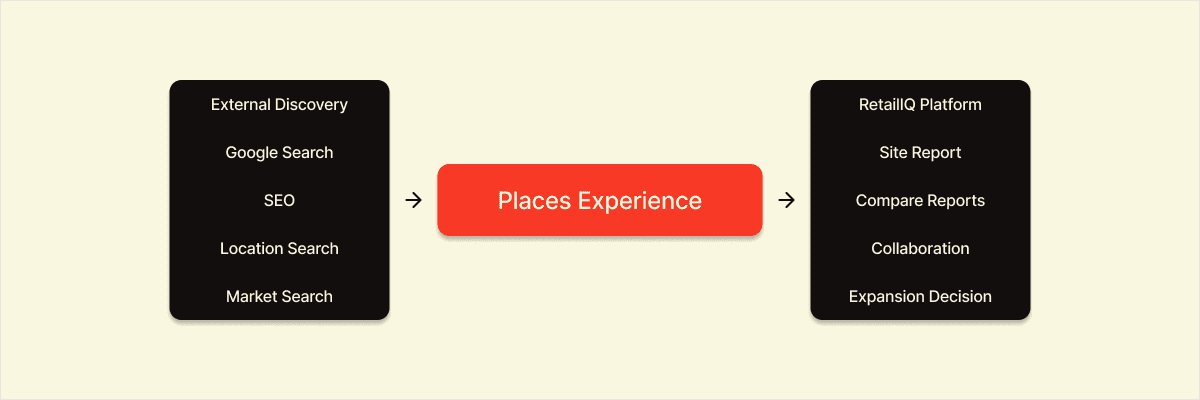
The Places experience is the gateway to RetailIQ. It not only improves discoverability through location-based search and SEO but also serves as the starting point for retail expansion teams to explore markets, discover opportunities, and seamlessly transition into deeper evaluation workflows.
The Problem
The Places experience contained extensive geographic and business intelligence, but discovering valuable opportunities required navigating dense maps, numerous filters, and disconnected information.
The challenge wasn't exposing more location data—it was helping users discover the right opportunities faster through a more intuitive exploration experience.

Constraints & Considerations
Cross-functional Feedback
Product priorities
GIS requirements
Engineering constraints
Business development workflows
User Constraints
Diverse search behaviours
Different levels of market familiarity
Large exploration space
Technical Feasibility
Large map datasets
Performance considerations
API limitations
Responsive interactions
Consistency
RetailIQ Design System
Existing navigation patterns
Platform consistency

Design Process
Reduce Exploration Friction
Minimize unnecessary searching, filtering, and navigation.
Progressive Disclosure
Surface essential information first while keeping advanced details accessible.
Support Spatial Thinking
Maps should help users make decisions rather than simply display locations.
Prioritize Discovery
Help users reach meaningful opportunities quickly.

Key Design Decisions
1. Search First, Explore Second
Designed search as the primary entry point to reduce manual map exploration.
2. Progressive Filtering
Advanced filters remain available without overwhelming first-time users.
3. Rich Location Cards
Surface meaningful business context before requiring users to open detailed reports.
4. Connected Map & List Experience
Keep spatial exploration and detailed information synchronized throughout the workflow.
Solution
Search
Improved discoverability through prioritized search and clearer result presentation.
Maps
Interactive map exploration with synchronized location context.
Filters
Progressive filtering designed for both simple and advanced exploration.
Location Cards
Structured information hierarchy supporting faster evaluation before entering detailed reports.

Business Impact
Increases product discoverability through SEO
Serves as the primary entry point into RetailIQ
Accelerates location exploration
Connects users to downstream evaluation workflows
Supports the entire retail expansion journey
User Impact
Reduced search effort
Easier map navigation
Better information discoverability
Simplified exploration workflow
Team Impact
Scalable exploration framework
Consistent interaction patterns
Reusable components across RetailIQ

What I Learned
Designing Discovery Experiences
Discovery is fundamentally different from reporting. Instead of helping users understand known information, the challenge is helping them uncover opportunities they haven't identified yet.
Key Trade-offs
Performance vs Information Density
Challenge
Rendering thousands of locations, filters, and business attributes could negatively impact performance.
Decision
Prioritized lightweight location markers and deferred loading detailed information until users interacted with a location.
Trade-off
Users perform one additional click to access detailed information, but the map remains responsive even with large datasets.
Rich Location Data vs Scanability
Challenge
Users wanted detailed information before opening a location, but displaying too much information made the cards difficult to scan and slowed exploration.
Decision
Prioritized the most decision-critical attributes on the location cards while moving secondary information into the detailed view.
Trade-off
Users see less information initially, but can compare and discover locations much faster.
