
Comments & Collaboration System
Designed communication workflows connecting internal teams and external stakeholders.
Responsibilities
Product Design | Workflow Design | UX Design | User Flows Stakeholder Alignment
300+
Active users
150+
Enterprise clients
3
Connected platforms
2k+
Conversations
Who used it?
Retail Expansion Teams
My role?
Product Designer
What was their goal?
Evaluate locations
Why was it difficult?
Conversations were fragmented
Why It Matters
Location decisions involve multiple stakeholders.
Without shared context and visibility, teams spend more time searching for information than acting on it.
The Problem
Property discussions and market feedback were spread across emails, calls, and messaging platforms.
As conversations moved between tools, context was lost, decisions became harder to track, and valuable market intelligence remained disconnected from the workflow.

Constraints & Considerations
Future Scalability
The initial release focused on communication.
Future phases were planned to support:
Source Attribution
Property-Level Tracking
Agent-Level Tracking
Workflow Visibility
Multiple User Types
The system needed to support:
Internal Business Development Teams
External Agents
Multiple Communication Flows
Platform Integration
The collaboration experience needed to integrate naturally within existing RetailIQ workflows.

Design Process
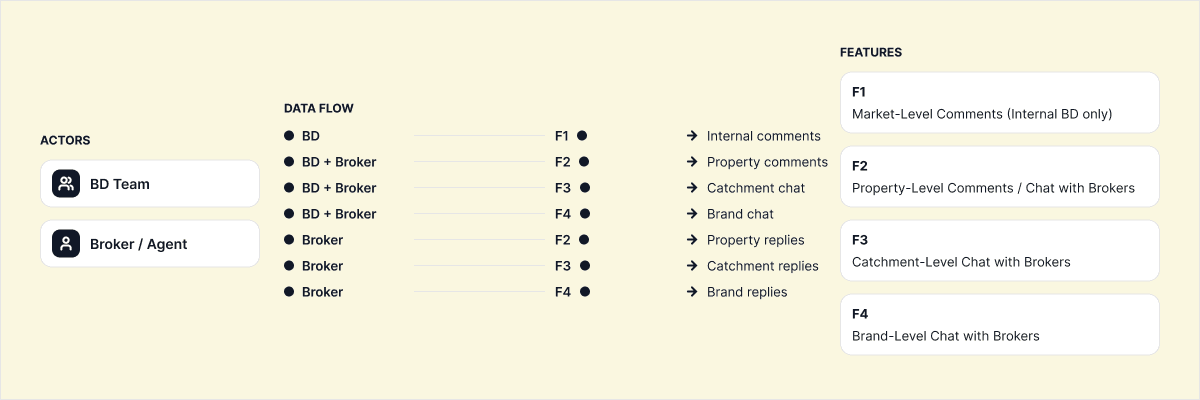
Mapping Communication Workflows
The first step was understanding how users currently exchanged information.
Key communication patterns included:
BD to BD
BD to Agent
Internal Discussions
External Discussions
Each flow carried different requirements and visibility rules.
Defining System Structure
The challenge was balancing:
Simplicity
Traceability
Scalability
Several interaction models were explored before arriving at a framework that could support both current and future use cases.

Key Design Decisions
1. Contextual Communication
Comments were attached directly to relevant entities and workflows instead of existing as separate conversations.
This reduced context switching.
3. Building for Future Expansion
The architecture considered future requirements such as source attribution and property-level tracking from the beginning.
2. Supporting Internal & External Collaboration
The system was designed to support different communication paths while maintaining a consistent experience.
4. Maintaining Visibility & Accountability
The design focused on ensuring that discussions remained accessible and traceable throughout the decision-making process.
Solution
The collaboration system introduced a centralized communication layer inside RetailIQ, allowing discussions, feedback, and decisions to remain connected to the properties and reports they relate to.

Business Impact
Established a communication foundation within the RetailIQ platform.
Reduced dependency on fragmented external communication channels.
Improved visibility into decision-related discussions.
User Impact
Enabled contextual collaboration around properties and reports.
Improved accessibility of stakeholder feedback.
Reduced loss of information across teams.
Team Impact
Created a scalable framework for future collaboration features.
Established groundwork for source attribution and workflow tracking initiatives.

What I Learned
Collaboration features are workflow problems first and interface problems second. Understanding how people communicate is more important than designing the communication tool itself.
Key Trade-offs
Immediate Needs vs Future Vision
The long-term goal included source attribution, property-level tracking, and workflow visibility. However, attempting to solve everything in a single release would have increased complexity and delayed delivery.
The decision was made to launch a focused communication experience first and establish a foundation for future enhancements.
Structured Communication vs Ease of Use
Highly structured communication models offered better traceability but introduced friction for users.
The final design balanced accountability and simplicity by keeping conversations contextual while minimizing additional effort.
Internal Control vs External Collaboration
The platform needed to support communication across internal teams and external stakeholders with different requirements and permissions.
The final framework was designed to accommodate multiple communication paths while maintaining a consistent experience.
